



Companies looking to solve a specific inspection task are generally not searching for a general introduction to industrial machine vision. They need information that fits their product, production process and quality objectives.
Which features need to be inspected? Which defects must be detected? Can the inspection be integrated into an existing production line? What requirements apply to operation, documentation and traceability? And how can an existing inspection system be operated reliably over the long term?
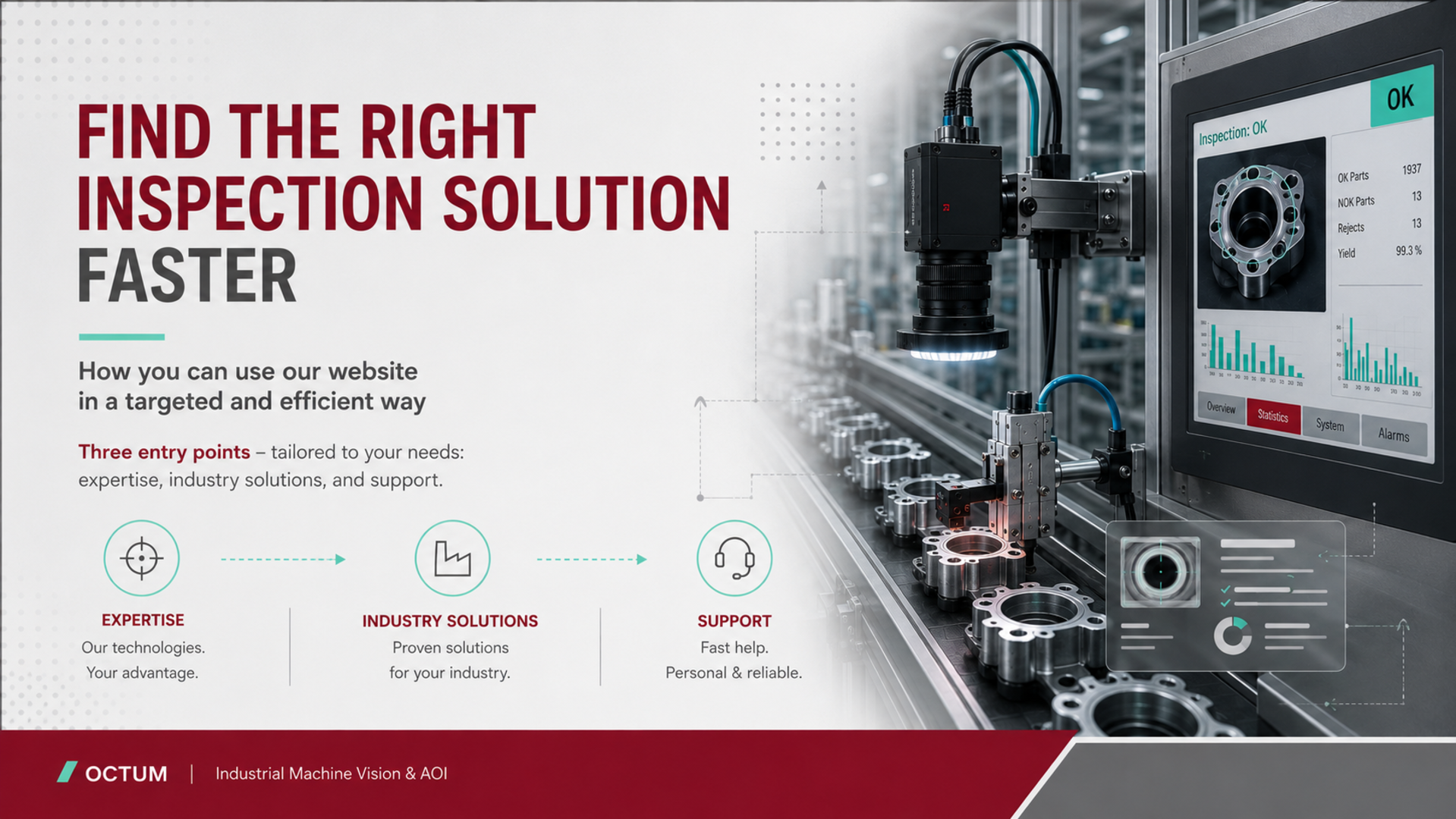
To help prospects and customers find the relevant information more quickly, the OCTUM website offers several different entry points. The sections Expertise, Industry Solutions and Support address different starting situations and guide users from the initial task to a specific solution or to services for existing systems.
The Right Entry Point Depends on the Task
Not every company starts from the same point. Some users already know exactly which inspection task they want to automate. Others are looking for a solution for a specific industry or production environment. Existing customers, on the other hand, often need information about service, training, repairs or technical support requests.
The website is therefore not structured exclusively around individual products or technologies. Instead, users can choose from three main routes:
- technical expertise and specific inspection tasks,
- industry-specific applications,
- or services for existing OCTUM systems.
These areas complement one another. Prospective customers can begin by exploring a typical industry solution and then move on to the relevant technologies, inspection methods or integration services in greater detail.
From Expertise to the Technical Solution
The Expertise section is aimed at companies dealing with a specific technical challenge. It focuses on industrial image processing, automated optical inspection, machine vision and the integration of inspection systems into machines and production lines.
A reliable inspection solution consists of more than just a camera. What matters is the coordinated interaction of different components and disciplines. These include:
- camera and image sensor,
- optics and required resolution,
- lighting and image acquisition conditions,
- image processing software and inspection algorithms,
- interfaces to the machine control system,
- product tracking and rejection logic,
- user interfaces and operating concepts,
- data storage and result transfer,
- as well as mechanical and electrical integration into the system.
The components and methods required depend on the specific inspection task. Inspecting the surface of a reflective metal component, for example, requires different image acquisition conditions than inspecting a transparent pharmaceutical product or checking a printed code on packaging.
The Expertise section therefore does not focus solely on individual technologies. It presents machine vision as a complete system.
The Inspection Task Comes Before the Technology
When developing an inspection solution, the first question should not be which camera or software to use. The initial task is to determine which quality features must be reliably captured and evaluated.
Typical inspection tasks include:
- presence and completeness checks,
- surface inspections,
- position and orientation checks,
- geometric measurements,
- OCR and OCV inspections,
- code inspection and traceability,
- print image and marking checks,
- contamination inspections,
- as well as the detection of assembly or material defects.
The inspection task determines the requirements for resolution, perspective, lighting, cycle time and evaluation. It is equally important to understand the variations that occur in the actual production process. These may include different product variants, material batches, positional tolerances, surfaces and environmental conditions.
Only once these factors are known can it be determined whether conventional image processing, machine learning or a combination of different methods is the most suitable solution.
Industry Solutions for Different Production Environments
The Industry Solutions section provides an application-oriented entry point. It focuses on typical products, processes and quality requirements in individual industries.
OCTUM develops inspection solutions for sectors including:
- pharmaceuticals,
- medical technology,
- packaging technology,
- automotive,
- metal processing,
- plastics processing,
- cosmetics,
- and other industrial production environments.
The fundamental technologies used in machine vision can be applied across industries. However, the requirements for implementation vary considerably.
In the pharmaceutical and medical technology sectors, for example, documentation, traceability, user management and transparent inspection results are particularly important. In metal processing, reflections, complex geometries and difficult-to-detect surface defects can affect image acquisition. In packaging technology, the focus is often on codes, plain text, labels, print images or the completeness of packaged products.
The Industry Solutions section therefore presents typical applications and explains how an inspection solution can be adapted to different production conditions.
Industry Knowledge Shortens the Path to the Right Solution
Experience gained in comparable production environments makes it easier to assess a new inspection task. Many challenges recur within an industry, even when the products and systems are not identical.
Typical examples include:
- high production speeds,
- numerous product and format variants,
- limited installation space,
- sensitive or reflective surfaces,
- cleaning requirements,
- strict documentation requirements,
- demanding process reliability and availability targets,
- as well as integration into existing machine concepts.
An industry-specific perspective therefore provides faster orientation. At the same time, every individual application is assessed separately. An existing system platform or proven solution may serve as a starting point, but it must still be adapted to the specific product and real production process.
System Integration Instead of a Retrofitted Stand-Alone Solution
Regardless of the industry or inspection task, early integration of machine vision is a key success factor.
When an AOI system is not considered until the end of machine planning, important conditions have usually already been defined. These include the available installation space, product handling, cycle time, trigger signals, rejection mechanisms and data flow.
A camera may still be added mechanically. However, this does not automatically result in a stable, maintainable and ergonomically operable inspection solution.
OCTUM therefore considers the machine, product, process and quality objective as a whole. Machine vision is planned as an integral part of the production line. This allows the camera, optics, lighting, software, interfaces and operation to be coordinated effectively.
Support for Existing OCTUM Systems
While the Expertise and Industry Solutions sections primarily focus on new projects and applications, the Support section is aimed at operators of existing OCTUM systems.
Customers can find information and contact options relating to:
- technical support requests,
- scheduled and unscheduled service calls,
- training,
- repair requests,
- maintenance and system support,
- modernization of existing systems,
- and the long-term operation of installed inspection systems.
Inspection systems are often used for many years. During this time, products, production volumes, operating systems, interfaces and quality requirements may change. Employees and responsibilities may also change.
A long-term support concept helps ensure that systems can continue to be operated, adapted and expanded reliably. Training enables operators, setup personnel and maintenance teams to use the available functions safely and classify faults more quickly.
From Initial Information to the Specific Inspection Task
The website provides initial orientation, but it does not replace the technical evaluation of a specific application.
Relevant information for designing an inspection system includes:
- the product to be inspected,
- the relevant quality features,
- known defect types,
- permissible product variations,
- production speed and cycle time,
- installation conditions and machine environment,
- existing interfaces,
- required responses in the event of a defect,
- and requirements for documentation and data storage.
Based on this information, it can be determined which image acquisition method is suitable and how the solution can be integrated into the production process. For complex or difficult-to-assess applications, a feasibility study can provide additional confidence.
Not Just Any Machine Vision System, but the Right Solution
The technical selection should always be based on the actual application. A powerful algorithm alone does not guarantee reliable quality control. Likewise, a high-resolution camera does not automatically produce a good inspection result.
What matters is a coordinated overall concept. Relevant features must be made visible, captured consistently, evaluated correctly and assigned unambiguously to the respective product. The results must be transferred to the machine control system or other systems, and defective products must be rejected reliably.
The different entry points on the OCTUM website are therefore intended to help companies find the information that best matches their situation:
- Expertise, when the technical inspection task is the main focus,
- Industry Solutions, when typical applications and industry-specific requirements are being explored,
- Support, when the operation or further development of existing systems is concerned.
Ultimately, the goal is not simply to use any machine vision solution. The goal is to develop an inspection solution that fits the product, the machine, the process and the quality objective.